Toaster Oven vs Conventional Oven: What to Know
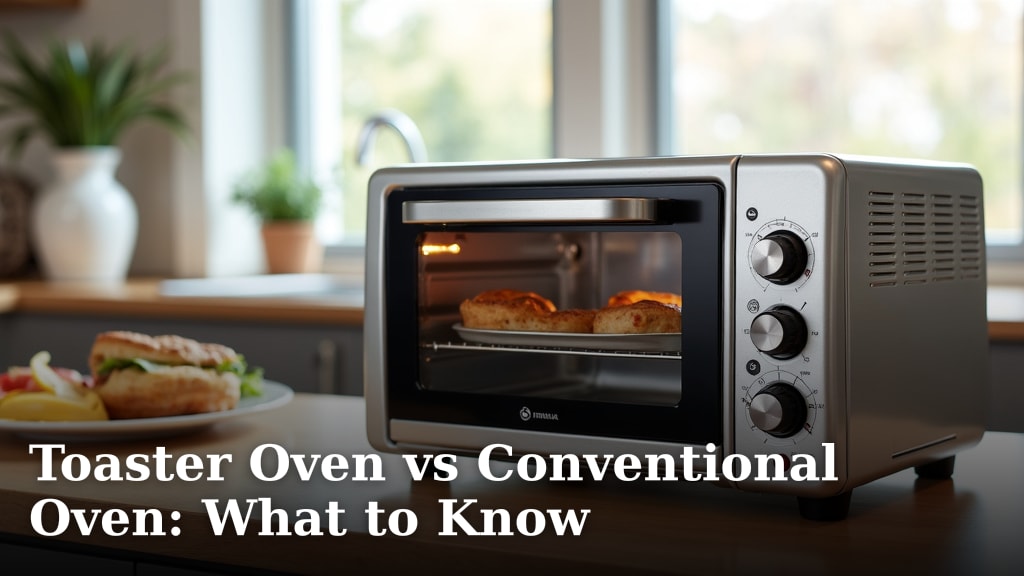
A toaster oven is best for small kitchens, quick snacks, and reheating leftovers. A conventional oven excels at baking large meals and batch cooking. When choosing between them, think about your cooking needs and the space you have.
Both appliances can toast bread, bake small items, and reheat food efficiently. Toaster ovens are faster for small jobs, while conventional ovens offer more space and even heating for bigger tasks. We found that understanding their key differences can save you time and energy.
- Toaster ovens are compact and great for small tasks.
- Conventional ovens are larger and handle big meals.
- Both can toast, bake, and reheat.
- Choose based on your kitchen size and cooking habits.
Let’s break down the pros and cons of each so you can decide which one is right for your kitchen.
Comparing Toaster Ovens and Conventional Ovens
When you’re thinking about kitchen appliances, the toaster oven and the conventional oven often come up. They might seem similar, but they have distinct strengths. We found that understanding these differences helps you pick the right tool for your cooking style. Let’s dive into what makes each one tick.
What is a Toaster Oven?
A toaster oven is a compact countertop appliance. It’s designed to toast bread, bake small batches, and reheat foods. Think of it as a mini version of your main oven. It often has a glass door so you can watch your food cook. Many models come with racks and a baking pan.
These ovens use heating elements, usually at the top and bottom. This allows for various cooking functions. You can toast, bake, broil, and sometimes even use convection settings. They heat up much faster than a full-sized oven. This makes them ideal for quick meals and snacks. We found them to be super convenient for busy mornings.
Toaster Oven Pros:
- Speedy preheating: They get hot in minutes.
- Energy efficient for small tasks: Uses less power than a big oven.
- Versatile for small jobs: Can toast, bake, broil, and reheat.
- Countertop friendly: Takes up less space.
- Easy to clean: Many have removable crumb trays.
Toaster Oven Cons:
- Limited capacity: Can’t cook large meals or multiple dishes at once.
- Uneven heating sometimes: Might need to rotate food for even cooking.
- Can get hot on the outside: Be careful when touching the surfaces.
- Takes up counter space: Although compact, it still uses prime real estate.
What is a Conventional Oven?
A conventional oven, often called a full-sized oven, is usually built into your kitchen cabinetry or comes as part of a range. It’s the workhorse of most kitchens. These ovens are designed for cooking larger meals and handling multiple dishes simultaneously. They offer more space and typically more consistent heating.
Conventional ovens use radiant heat from heating elements, usually at the top and bottom. Many also feature a convection fan. This fan circulates hot air. It helps cook food more evenly and often faster. They are essential for baking cakes, roasting a whole chicken, or preparing holiday feasts. We found that their larger size is key for family meals.
Conventional Oven Pros:
- Large capacity: Easily handles big roasts, multiple baking sheets, or large casseroles.
- Even cooking: Generally provides more consistent heat distribution, especially with convection.
- Ideal for baking: Offers the space and controlled temperature needed for baking projects.
- Can cook multiple items: You can prepare different dishes at the same time.
- Doesn’t take up counter space: Usually integrated into your kitchen design.
Conventional Oven Cons:
- Slow to preheat: Takes longer to reach the desired temperature.
- Less energy efficient for small tasks: Heating a large oven for a single slice of toast is wasteful.
- Requires more space: Needs dedicated installation space.
- More complex cleaning: Self-cleaning features help, but deep cleaning can be a chore.
Key Differences and When to Choose Which
The main distinctions boil down to size, speed, and suitability for different tasks. A toaster oven is your go-to for quick, smaller jobs. A conventional oven is built for volume and more involved cooking.
Capacity and Size: What Fits Your Needs?
This is often the biggest deciding factor. If you live alone or with one other person, a toaster oven might be sufficient for most of your needs. You can toast bread, heat up a slice of pizza, or bake a couple of cookies. But if you’re feeding a family of four or more, or you frequently entertain guests, a conventional oven’s larger capacity is essential. We found that trying to fit a large turkey into a small toaster oven is simply not an option.
Speed and Efficiency: Saving Time and Energy
Toaster ovens win hands down when it comes to speed. They preheat in mere minutes. This is a huge advantage for busy individuals or families. Imagine wanting a quick grilled cheese sandwich – a toaster oven can have it ready in under 10 minutes. Conventional ovens, on the other hand, can take 15-20 minutes just to preheat. While convection fans speed things up, they still lag behind toaster ovens for small-scale cooking. For energy use, heating a small toaster oven for a single serving is far more efficient than powering up a large conventional oven.
Many guidelines suggest using the smallest appliance that can do the job efficiently (U.S. Department of Energy). This principle strongly favors toaster ovens for small tasks. Heating a large oven to 350°F for a single baked potato is like using a sledgehammer to crack a nut. It’s a waste of energy and time.
Cooking Performance: Beyond Toasting
For baking, conventional ovens generally offer more precise and even temperature control. This is vital for delicate items like cakes, soufflés, and bread. The larger chamber allows hot air to circulate more uniformly. Toaster ovens can sometimes create hot spots, leading to uneven browning. However, many modern toaster ovens, especially those with convection, perform admirably for smaller baking projects. We found that for things like muffins or a small batch of cookies, a good toaster oven can produce excellent results.
Broiling is another function where differences emerge. Conventional ovens usually have a more powerful broiler. This is great for searing steaks or browning the top of a casserole. Some toaster ovens have broil settings, but they might not be as intense. Always check the wattage and reviews for specific models if broiling is a priority for you.
Countertop vs. Built-In: Kitchen Space Matters
Your kitchen’s available space is a major consideration. If you have a small kitchen with limited counter space, a toaster oven might feel like just another appliance cluttering your workspace. Conversely, if you lack a built-in oven, a toaster oven can provide baking and broiling capabilities without requiring major renovations. For those with ample space, a conventional oven is usually a standard feature. It frees up counter space and offers greater cooking capacity.
Ease of Use and Cleaning: Daily Convenience
Toaster ovens are generally simpler to operate. You select a function (toast, bake, broil) and set a temperature or time. Cleaning is also often easier thanks to removable crumb trays and non-stick interiors. Conventional ovens can be more complex, with multiple modes and precise temperature settings. While self-cleaning features are helpful, the process can take several hours and emit odors. For everyday use and quick cleanups, many find toaster ovens more user-friendly.
Toaster Oven vs. Conventional Oven: At a Glance
| Feature | Toaster Oven | Conventional Oven |
|---|---|---|
| Primary Use | Small tasks, snacks, reheating | Large meals, batch baking, roasting |
| Capacity | Small (1-2 servings) | Large (4+ servings) |
| Preheat Time | Very fast (2-5 minutes) | Slow (15-20 minutes) |
| Energy Efficiency | High for small tasks | Lower for small tasks, better for large volume |
| Counter Space | Requires counter space | Built-in, saves counter space |
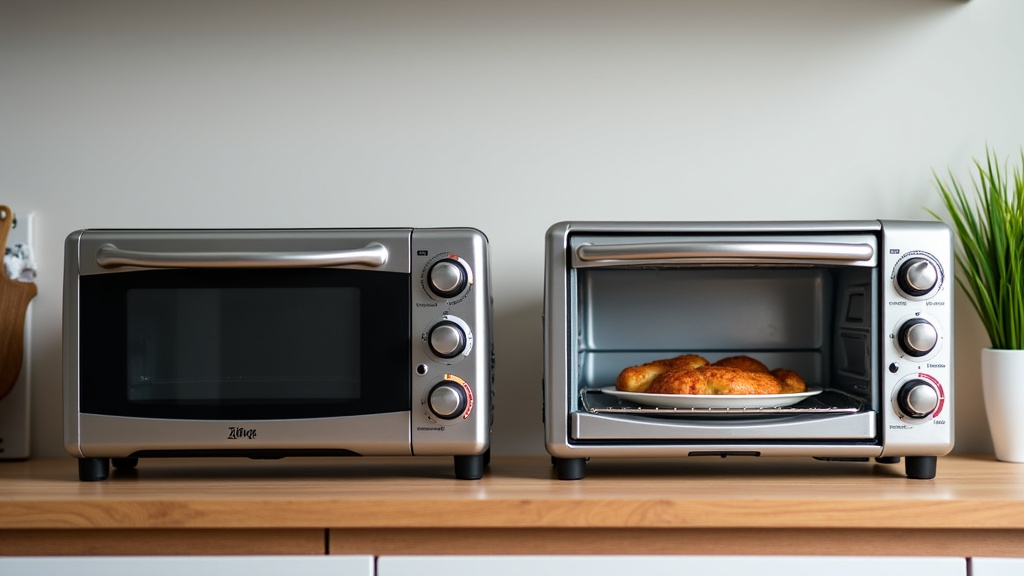
| Ideal For | Singles, couples, dorm rooms, quick meals | Families, frequent entertainers, serious bakers |
Making Your Decision: A Checklist
To help you decide, consider these questions:
- How many people do you typically cook for?
- What kinds of foods do you prepare most often?
- How much counter and kitchen space do you have?
- How important is speed and quick preheating to you?
- What is your budget for kitchen appliances?
- Do you have an existing oven, or are you starting from scratch?
Conclusion
Choosing between a toaster oven and a conventional oven really comes down to your cooking habits and kitchen space. For quick snacks, reheating leftovers, or preparing meals for one or two, a toaster oven is a speedy and energy-efficient choice. If you’re often cooking for a crowd, baking large batches, or roasting big items, your conventional oven is likely the better fit. We found that understanding these core differences will help you make the best decision. Think about what you cook most often and how much space you have. Then, you can confidently pick the appliance that suits your needs best.
Frequently Asked Questions
Can a toaster oven replace a conventional oven entirely?
For many people, especially those cooking for one or two, a good toaster oven can handle most daily tasks. However, it generally can’t replace a conventional oven for large meals, multiple dishes at once, or complex baking projects. Think of it as a great supplement or primary appliance for smaller kitchens.
Which is better for baking: a toaster oven or a conventional oven?
Conventional ovens typically offer more even heat distribution and larger capacity, making them ideal for baking cakes, bread, and multiple items. While some advanced toaster ovens with convection can do a good job with smaller batches, they might not provide the same consistent results for delicate baked goods.
Do toaster ovens use less energy than conventional ovens?
Yes, for small tasks like toasting bread, reheating a slice of pizza, or baking a single cookie, a toaster oven uses significantly less energy. Heating a large conventional oven for these small jobs is inefficient. However, for cooking large meals, a conventional oven might be more energy-efficient per serving than trying to cook the same meal in multiple batches in a toaster oven.
How much counter space does a toaster oven take up?
Toaster ovens vary in size, but they are designed to sit on your countertop. Even the most compact models will occupy a dedicated space, usually similar to a large microwave. You need to ensure you have adequate ventilation around it as well, as the exterior can get hot.
Is a convection toaster oven different from a regular toaster oven?
Yes, a convection toaster oven has a fan that circulates hot air. This helps cook food more evenly and often faster than a standard toaster oven without a fan. Many users find convection settings improve results for baking and roasting small items.