How to Use a Hamilton Beach Toaster Oven
To use a Hamilton Beach toaster oven, choose the cooking function, set the temperature and timer, place food on the correct rack, and let the oven preheat when the recipe calls for it. Adjust the rack and cooking time for the food's size and browning needs.
On this page (10 sections)
- What do the Hamilton Beach toaster oven controls do?
- Which rack position should you use?
- How should you use bake, toast, and broil?
- How do you preheat a Hamilton Beach toaster oven?
- What cookware fits a Hamilton Beach toaster oven?
- Can a Hamilton Beach toaster oven replace a full-size oven?
- When is a countertop roaster more useful?
- How do you use convection on a Hamilton Beach toaster oven?
- What safety steps matter most?
- How do you choose the right setting for each task?
To use a Hamilton Beach toaster oven, select the cooking function, set the temperature, choose the rack position, and set the timer. Use the middle rack for most foods, move food closer to the top for browning, and check the manual for the exact control layout on your model.
Hamilton Beach makes several toaster oven designs, so the labels and knob order can vary. The basic process stays similar: place the rack, add the food in suitable bakeware, choose the function, set the temperature, and monitor the food near the end.
For an Oster model, follow Oster toaster oven instructions.
For a broader overview, see What Is a Toaster Oven Used For? Explained.
What do the Hamilton Beach toaster oven controls do?
The function control chooses how the oven heats, the temperature control sets the heat level, and the timer controls cooking time. Some models also include a dedicated toast shade control or a convection setting.
Common functions include bake, broil, toast, and convection. Bake uses the oven for general cooking, broil places food under stronger top heat, toast is designed for bread and similar items, and convection circulates hot air when that feature is available.
Set the temperature before setting the timer if your model uses a mechanical control. A timer knob may need to be turned past a short starting point before being set to the desired minutes.
A toaster oven may continue heating until the timer ends or until you turn the controls off. Stay nearby during broiling and toasting because food can brown quickly close to the upper element.
For a general control sequence, read how to work a toaster oven.
Which rack position should you use?
Use the middle rack for baking, reheating, and most everyday cooking. The upper rack suits quick browning or broiling, while the lower rack gives taller food more space from the top element.
Leave room around the food so heated air can move. Don't let a pan touch the sides, top, door, or heating elements.
Use the lower position for items with more height, such as a small casserole or a pan of vegetables. Check the door clearance before starting, especially when using a deep dish.
The temperature a toaster oven can reach helps explain why rack distance matters. A smaller oven can brown the top of food quickly even when the center still needs time.
How should you use bake, toast, and broil?
Choose bake for cakes, casseroles, vegetables, and most reheating. Choose toast for bread, and use broil for foods that need direct heat from above.
For bake, place the rack in the middle or lower position and use an oven-safe pan. Preheat when the recipe depends on a fully heated oven, then set the timer after the food goes in.
For toast, place slices in a single layer on the rack. Start with a lighter shade or shorter time until you learn how quickly your model browns bread.
For broil, place food on a suitable pan and keep it near the upper element without letting it touch. Watch continuously, turn food when needed, and use the manual's safety directions.
When a recipe gives a conventional oven temperature, begin with that temperature unless the recipe or Hamilton Beach manual says to adjust it. A convection setting may cook food faster, so check it early.
How do you preheat a Hamilton Beach toaster oven?
Set the function and temperature, then allow the oven to heat before adding food when preheating matters. The correct time depends on the model, temperature, food, and recipe.
Keep the door closed during preheating. Opening it releases heat and can make the cooking time less predictable.
Some foods do not need a long preheat. Toast and small reheating tasks may be ready quickly, while cakes, biscuits, and casseroles usually benefit from a heated oven.
Use an oven thermometer only if you need to check temperature behavior over time. Don't rely on the outside of the oven to judge its internal temperature.
What cookware fits a Hamilton Beach toaster oven?
Use an oven-safe pan that leaves clearance around the food and heating elements. Measure the interior and compare it with the pan before cooking.
The Chicago Metallic 4-Piece Toaster Oven Bakeware Set includes a 9.5 x 6.25 in baking pan, a 9.25 x 6 in cooling rack, an 11 x 7 in roast/cake pan, and a 6-cup muffin pan. The pieces are made from heavy-weight aluminized steel with a nonstick coating, are oven safe to 450°F, and nest for storage.
Choose the smallest pan that gives the food enough space. A crowded pan can slow cooking and make browning uneven.
The set is useful for people who need several pan shapes for a small oven. Hand washing is recommended to help extend the life of the nonstick coating, even though the pieces are dishwasher safe.
Can a Hamilton Beach toaster oven replace a full-size oven?
A Hamilton Beach toaster oven can handle smaller portions, toast, reheating, and many baked foods, but it doesn't replace every full-size oven task. For models built to handle several jobs, compare multi-use toaster ovens.
Interior space, pan size, temperature control, and cooking time limit what fits.
Use it when you want to cook a small portion without heating a larger oven. Check the oven's clearance before using tall dishes or foods that rise.
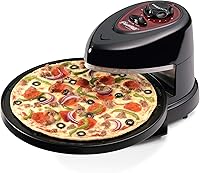
The Presto 03430 Pizzazz Plus Rotating Oven suits readers focused on pizza and similar convenience foods. Its 12 in size has a continuously rotating tray, separately controlled top and bottom heating elements, a timer with automatic shutoff, and a removable nonstick baking pan.
This appliance differs from a Hamilton Beach toaster oven because its main design centers on rotating foods while the heating elements can be selected separately. It may suit a pizza-focused kitchen, but it doesn't provide the same general rack-and-pan setup.
Keep the appliance on a stable, heat-safe surface and allow the clearance required by its instructions. Let the pan cool before removing it for cleaning.
When is a countertop roaster more useful?
A countertop roaster is better for larger moist dishes that need a covered cooking vessel than for toast or small slices of bread. It can supplement a toaster oven when you need another cooking space.
The NESCO 4816‑14 Electric Roaster Oven for Everyday Home Cooking, White 6‑Quart Countertop Roaster with Porcelain Coated Steel Cookwell has a 6-quart capacity, a white finish, a porcelain-coated steel cookwell, and a 200°F–450°F temperature range. It is designed for roasting, baking, cooking, steaming, and serving.
Its 6-quart size gives it a different role from a toaster oven. Choose it when the dish needs a deeper cookwell or covered roasting space, and choose the Hamilton Beach toaster oven for toast, open-pan baking, and compact reheating.
The removable cookwell has a non-porous porcelain surface and stay-cool side handles. Let it cool before cleaning, and follow the care instructions for the cookwell and heating unit.
How do you use convection on a Hamilton Beach toaster oven?
Use convection when you want circulating hot air and faster, more even cooking around the food. Start checking the food early because convection can change browning and cooking time.
Leave space between pieces rather than packing the pan tightly. Air movement matters more when using convection, especially for vegetables, cookies, and other foods spread across a tray.
If a recipe gives a convection adjustment, follow it. If it doesn't, keep the stated temperature and check the food before the full cooking time ends.
Convection doesn't make every pan or food suitable for the oven. Use bakeware that fits safely, and keep paper, plastic, and other heat-sensitive items away from the interior.
What safety steps matter most?
Keep the toaster oven away from water, never block its vents, and don't allow food or foil to touch the heating elements. Unplug it before cleaning and let hot pans cool before handling them.
Use dry oven mitts when removing cookware. Wet fabric can transfer heat quickly and cause burns.
Don't leave broiling food unattended. Grease, crumbs, and food debris can smoke or ignite near strong top heat.
Clean the crumb tray regularly and remove loose crumbs from the interior after the oven cools. If you see damaged cords, controls, or heating elements, stop using the appliance and follow Hamilton Beach support guidance.
For replacement needs, see best Hamilton Beach toaster oven replacement parts.
How do you choose the right setting for each task?
Match the function to the food, the rack to the heat source, and the pan to the oven's interior. That simple rule prevents most uneven browning and clearance problems.
Use bake and the middle rack for casseroles, small cakes, and general cooking. Use toast for bread, broil for top browning, and convection when circulating air suits the food and your model includes it.
Use the Chicago Metallic set for small-batch pans and muffins. Consider the Presto for rotating 12 in pizza, or the NESCO for 6-quart covered cooking and larger moist dishes.
If your kitchen also needs a compact microwave, compare best 1000 watt countertop microwaves. For another brand's control layout, read how to use a Cuisinart toaster oven.
The best way to use a Hamilton Beach toaster oven is to start with the manual's control instructions, use the middle rack for most foods, and check small portions early. Choose a dedicated pizza oven when pizza is the main task, bakeware when pan size is the problem, and a countertop roaster when you need a deeper 6-quart cooking vessel.
Frequently asked questions
How do you preheat a Hamilton Beach toaster oven?
Set the cooking function and temperature, then turn the timer on for the preheat period recommended by your recipe or manual. Wait until the oven reaches the selected temperature before adding food when the recipe depends on a fully heated oven.
What rack position should you use in a Hamilton Beach toaster oven?
Use the middle position for most baking and reheating. Move the rack higher when you want food closer to the top heating element for browning, and use a lower position for foods that need more distance from direct top heat.
Can you use aluminum foil in a Hamilton Beach toaster oven?
Use aluminum foil only when the Hamilton Beach manual and the recipe allow it. Keep foil away from the heating elements, don't cover the crumb tray or the entire rack, and never let foil block airflow or touch the oven walls.
How do you clean a Hamilton Beach toaster oven?
Unplug the toaster oven and let it cool fully before cleaning. Remove and empty the crumb tray, wipe the interior with a damp cloth, wash approved removable parts, and avoid immersing the appliance or using abrasive cleaners.